
Few things bring people into the emergency room faster than a kidney stone attack. The pain often comes on suddenly, can be severe enough to make it hard to sit still, and tends to come in waves which is part of why kidney stones have earned a reputation as one of the more dramatic conditions in medicine, even though they’re rarely dangerous in themselves. At Indigo Hospital, we see kidney stones across all age groups, and the good news is that most cases are very treatable, with many resolving without any major procedure at all. Here’s a closer look at how stones form, what causes them, and how they’re typically treated.
What Exactly Is a Kidney Stone?
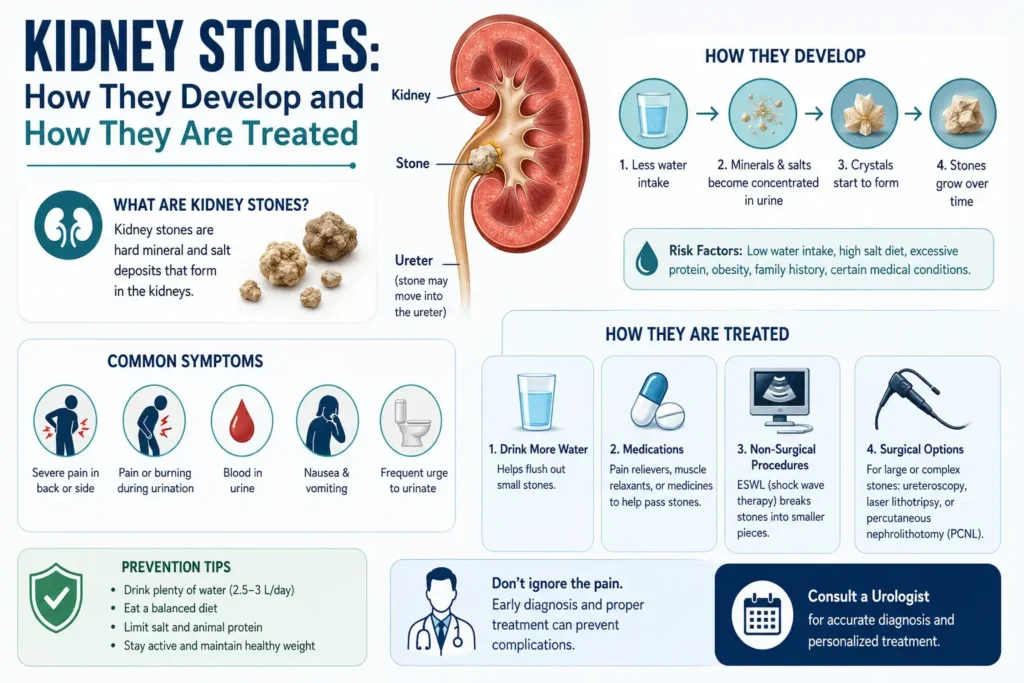
Your kidneys constantly filter waste products and extra minerals out of your blood, sending them out of the body in urine. Normally, these substances stay dissolved and flow out without any issue. But sometimes, certain substances particularly calcium, oxalate, and uric acid become too concentrated in the urine. When that happens, tiny crystals can start to form, and over time, these crystals can stick together and grow into a hard, solid mass. That’s a kidney stone.
Stones can be as small as a grain of sand or as large as a golf ball, though most are on the smaller end. Their size, shape, and location all play a big role in whether they cause symptoms and how they’re best treated.
What Causes Kidney Stones?
Kidney stones form when there’s an imbalance between the substances that can form crystals and the fluid available to keep them dissolved. A number of factors can contribute to this:
- Not drinking enough water — this is one of the biggest factors, since concentrated urine makes it easier for crystals to form
- Diet — high salt intake, too much animal protein, or foods high in a substance called oxalate (found in things like spinach and nuts) can increase the risk for certain types of stones
- Family history — if close relatives have had kidney stones, you’re more likely to develop them too
- Certain medical conditions — including conditions that affect how the body handles calcium, as well as some digestive and metabolic conditions
- Being overweight — this is linked to a higher risk of stone formation
- Hot climates — living somewhere warm, or doing physical work that causes a lot of sweating, can increase the risk by reducing how much fluid ends up in the urine
- Certain medications and supplements — some can increase the risk of stones forming over time
What Are the Symptoms?
Not all kidney stones cause symptoms small ones can sometimes pass without the person ever noticing. But when a stone is large enough to get stuck or cause a blockage, symptoms can include:
- Sudden, severe pain — often in the back or side, below the ribs, that can come in waves
- Pain that moves — sometimes spreading toward the lower belly and groin as the stone moves
- Pain when urinating
- Blood in the urine — which can make urine look pink, red, or brown
- Cloudy or bad-smelling urine
- Needing to urinate more often, or in small amounts
- Nausea and vomiting — often accompanying the pain
- Fever and chills — if there’s also an infection, which needs prompt attention
How Are Kidney Stones Diagnosed?
If a kidney stone is suspected, doctors typically start with a discussion of symptoms and a physical examination, followed by some combination of:
- Urine tests — to check for blood, signs of infection, and sometimes to analyze crystals
- Blood tests — to check kidney function and levels of substances like calcium
- Imaging scans — a CT scan is often the most detailed way to see the size, location, and number of stones, though ultrasound and X-rays are also used in certain situations
How Are Kidney Stones Treated?
Treatment depends largely on the size of the stone, where it’s located, and whether it’s causing a blockage or infection. Many stones, especially smaller ones, can pass on their own with some support along the way.
For smaller stones, treatment often includes:
- Drinking plenty of water — to help flush the stone out naturally
- Pain relief medication — to manage discomfort while waiting for the stone to pass
- Medication to relax the tube that carries urine — this can make it easier for the stone to pass through
- Monitoring — with follow-up to confirm the stone has passed and check that everything looks normal afterward
For larger stones, or ones that aren’t passing on their own, options include:
- Shock wave treatment — uses focused sound waves from outside the body to break the stone into smaller pieces that can then pass more easily
- A small camera passed through the natural urinary passage — allowing a doctor to locate the stone and break it up or remove it directly, without any cuts on the body
- A small puncture in the back — used for larger stones, where a narrow tool is guided directly to the stone to break it up and remove the pieces
Most of these procedures are done with the patient asleep under anesthesia, and many people go home the same day or after a short stay, with a relatively quick return to normal activities.
Can Kidney Stones Come Back?
Yes once someone has had a kidney stone, they have a meaningfully higher chance of developing another one in the future. This is why, after a stone has been treated or has passed, doctors often recommend some follow-up steps:
- Testing the stone itself, if it’s been collected, to understand what it’s made of
- Blood and urine tests to look for any underlying imbalance that might be contributing
- Personalized advice on fluid intake and diet, based on the type of stone and the test results
For many people, relatively simple changes drinking more water throughout the day being the single most important one can make a meaningful difference in reducing the chances of another stone forming.
When Should You See a Doctor Urgently?
While many kidney stones can be managed without an emergency visit, certain situations need prompt medical attention:
- Severe pain that isn’t controlled by over-the-counter pain relief
- Fever or chills along with the pain — this can suggest an infection alongside the stone, which needs urgent treatment
- Persistent vomiting, making it hard to stay hydrated
- Visible blood in the urine, especially if it’s heavy or persistent
- Difficulty urinating at all
The Bottom Line
Kidney stones are extremely common, often very painful, but in most cases, very treatable and frequently without the need for any major procedure. For larger stones or ones causing complications, there are well-established treatment options that are generally quick and have good outcomes. Just as importantly, for anyone who’s had a stone before, there are practical steps that can meaningfully lower the risk of going through it again.
At Indigo Hospital, our team is equipped to evaluate kidney stones quickly, recommend the right treatment based on the size and location of the stone, and help patients understand what steps might help prevent future episodes. If you’re experiencing symptoms that might be a kidney stone, especially sudden severe pain, don’t hesitate to get checked out.
Indigo Hospital
2nd Floor, Marathon Millennium, Lal Bahadur Shastri Marg, Beside Nirmal Lifestyle Mall, Moti Nagar, Mulund Colony, Mulund West, Mumbai, Maharashtra 400080
Phone: +91 93727 23701
Reach Us: https://share.google/nXBN0sPXJVFYjgCEU
Frequently Asked Questions
Are kidney stones dangerous?
On their own, most kidney stones aren’t dangerous, though they can be extremely painful. They become more serious if they cause a complete blockage along with an infection, which is why symptoms like fever combined with severe pain need prompt attention.
How long does it take for a kidney stone to pass?
This varies a lot depending on the size and location of the stone. Smaller stones may pass within a few days to a couple of weeks with the help of fluids and medication, while larger stones may need a procedure to help them pass or to remove them directly.
Do I need surgery for a kidney stone?
Not necessarily. Many stones, especially smaller ones, pass on their own with supportive treatment like fluids and pain relief. Procedures are usually only needed for larger stones, stones that are causing a blockage, or stones that aren’t passing despite waiting.
Will drinking more water really help prevent kidney stones?
Yes, for most people, this is one of the most effective and simplest preventive steps. Staying well hydrated helps keep substances in the urine dilute enough that they’re less likely to form crystals in the first place.
What's the recovery like after a kidney stone procedure?
Recovery depends on the type of procedure, but many of the common treatments for kidney stones are done without any large cuts, and most people go home the same day or after a short stay, returning to normal activities relatively quickly.
Where can I get evaluated if I think I have a kidney stone?
At Indigo Hospital, our team can evaluate your symptoms, run the appropriate tests and scans, and recommend the right treatment based on the size, location, and type of stone involved.
