
If you’ve ever bent down to pick something up off the floor and felt a sudden, sharp jolt of pain shoot through your back followed by days of stiffness, or even pain running down your leg there’s a good chance you’ve experienced, or come close to experiencing, a slipped disc. It’s one of the most common causes of back pain, and also one of the most misunderstood. The good news is that for the vast majority of people, a slipped disc gets better on its own with time and the right care. Surgery is far less common than most people assume but for a smaller group of patients, it can make a real difference. At Indigo Hospital, here’s how we explain what’s actually going on, and how we decide what level of treatment is right.
What Exactly Is a Slipped Disc?
Think of your spine as a stack of building blocks with a soft cushion sitting between each pair, acting like a shock absorber. These cushions are called discs, and each one has a tough outer layer wrapped around a softer, gel-like center.
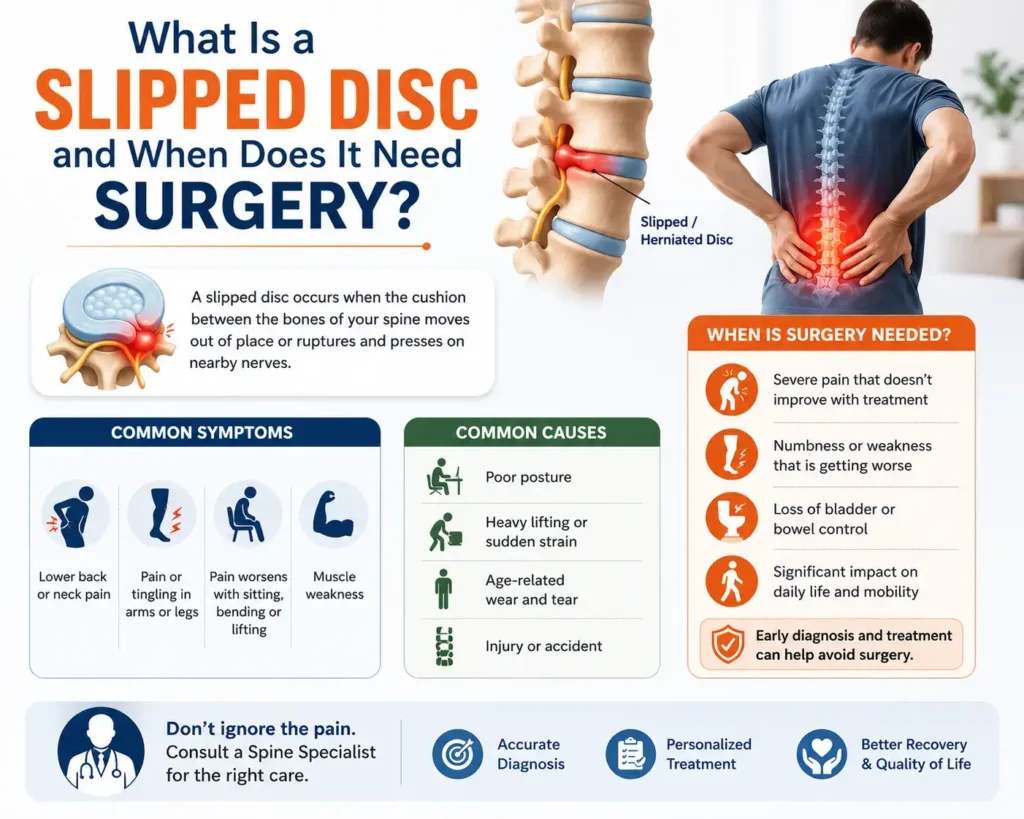
A “slipped disc” doesn’t actually mean the cushion has slipped out of place like a coin sliding off a table. What really happens is that the tough outer layer develops a small crack or weak spot, and some of the softer material inside pushes out through it a bit like the filling squeezing out of an over-stuffed sandwich. This bulge can sometimes press against a nearby nerve, which is what causes many of the symptoms people associate with the condition.
Slipped discs most commonly occur in the lower back and the neck, since these areas carry the most movement and the most load.
What Causes It?
A slipped disc usually doesn’t happen out of nowhere it’s often the result of gradual wear and tear, sometimes combined with a specific triggering moment. Common contributing factors include:
- Wear and tear with age — the cushions naturally become less flexible over time, making them more prone to small cracks
- Repeated strain — jobs or activities involving frequent bending, twisting, or heavy lifting
- A sudden wrong movement — lifting something heavy with poor form, or a sudden awkward twist
- Extra body weight — which adds more load on the lower back
- Sitting a lot and weak muscles — a weak core and back provide less support for the spine
- Family history — some people are simply more prone to this than others
What Does It Feel Like?
Symptoms can vary quite a bit depending on where the problem is and whether it’s pressing on a nerve. Common signs include:
- Pain in the back or neck — often worse with certain movements, sitting, or coughing
- Pain that travels — down the arm or down the leg, depending on where the issue is
- Numbness or tingling — in the area affected
- Weakness — in the arm, leg, or foot, depending on what’s affected
- Pain that changes with position — worse when sitting for long periods, sometimes better when lying down
It’s worth noting that some people have this issue show up on a scan but feel no symptoms at all which is part of why scan results need to be looked at alongside an actual physical check-up, not on their own.
How Is It Diagnosed?
Diagnosis typically starts with a detailed conversation about your symptoms and a physical examination, where the doctor checks things like reflexes, strength, and areas of numbness to get a sense of what might be affected.
If needed, a scan may be used to confirm the diagnosis and get a clearer picture:
- MRI scans are the most useful, since they show the discs and nerves in detail
- CT scans can also help and are sometimes used when an MRI isn’t suitable
- X-rays don’t show the discs directly but can help rule out other causes of back pain, such as a fracture
How Is a Slipped Disc Usually Treated?
Here’s the part that often surprises people: most slipped discs improve with simple treatment, often within a matter of weeks to a few months. The body has a natural tendency to gradually heal this kind of injury over time, and reducing pressure on the nerve through other means can relieve symptoms even before that happens.
Non-surgical treatment options typically include:
- Rest and avoiding certain movements — not complete bed rest, but staying away from movements that make the pain worse
- Physical therapy — guided exercises to relieve pressure, strengthen supporting muscles, and improve posture
- Pain and anti-inflammatory medication — to manage symptoms while things improve underneath
- Injections — for more persistent pain, these can reduce swelling around the affected nerve
- Heat or cold therapy — for short-term relief
For most patients, a combination of these approaches leads to significant improvement, and many people return to normal activity without ever needing surgery.
When Does Surgery Become Necessary?
Surgery is generally considered only when certain conditions are met it’s rarely the first step, and it’s not a decision made lightly. Surgery may be recommended when:
- Symptoms don’t improve despite several weeks (often 6-12 weeks) of consistent non-surgical treatment
- Pain is severe and significantly affects daily life, despite medication and therapy
- There’s ongoing weakness in the affected arm or leg that’s getting worse
- There’s sudden loss of bladder or bowel control this is rare but serious, and needs urgent medical attention
- A scan confirms that the bulge matches the symptoms and the area that’s affected
In these situations, surgery aims to relieve pressure on the affected nerve by removing the small portion of the disc that’s pressing on it. In some cases, this is done using techniques that involve smaller cuts, which often allow for a quicker recovery compared to traditional surgery with a larger incision.
What Does Recovery Look Like?
Recovery depends heavily on whether treatment is surgical or non-surgical, and on the individual patient.
Without surgery, many people see gradual improvement over several weeks, with physical therapy playing a key role in both recovery and preventing the problem from coming back.
With surgery, many patients experience significant relief from nerve-related symptoms relatively quickly, though full recovery including a gradual return to activity and rehabilitation exercises typically takes several weeks to a few months, depending on the type of procedure performed.
In both cases, long-term outcomes are often improved by addressing the underlying contributing factors building core strength, maintaining a healthy weight, and learning safer ways to move during daily activities.
The Bottom Line
A slipped disc can be alarming when it first happens, especially if it comes with sudden, radiating pain. But for most people, it’s a condition that improves with time, patience, and the right combination of simple treatments. Surgery remains an important option for a smaller group of patients particularly when there’s significant nerve involvement or symptoms that simply aren’t improving but it’s a decision made carefully, based on a clear overall picture rather than a scan result alone.
At Indigo Hospital, our spine specialists focus on understanding each patient’s specific symptoms, examining how the condition is affecting daily life, and recommending a treatment path surgical or non-surgical that fits the individual situation. If you’re dealing with persistent back or neck pain, especially with numbness, tingling, or weakness, our team is here to help you understand what’s going on and what your options look like.
Indigo Hospital
2nd Floor, Marathon Millennium, Lal Bahadur Shastri Marg, Beside Nirmal Lifestyle Mall, Moti Nagar, Mulund Colony, Mulund West, Mumbai, Maharashtra 400080
Phone: +91 93727 23701
Reach Us: https://share.google/nXBN0sPXJVFYjgCEU
Frequently Asked Questions
Can a slipped disc heal on its own?
Yes, in many cases. The body can gradually heal this kind of injury over time, and symptoms often improve significantly within a few weeks to a few months with simple care, including rest, physical therapy, and medication.
Does a slipped disc always cause pain?
No. Some people have this show up on a scan but feel no symptoms at all. This is part of why doctors look at the full picture symptoms, a physical check-up, and scans together rather than treating a scan result on its own.
How long should I try non-surgical treatment before considering surgery?
There’s no single answer, but doctors often recommend giving non-surgical treatment several weeks commonly around 6 to 12 weeks before seriously considering surgery, unless there are warning signs like worsening weakness or loss of bladder/bowel control, which need prompt evaluation.
Can exercise make a slipped disc worse?
The right kind of exercise particularly guided physical therapy is usually part of the treatment plan and can help relieve symptoms and prevent the problem from coming back. However, certain movements, especially heavy lifting or twisting, can make symptoms worse during a flare-up, so it’s important to follow guidance from a healthcare professional about what’s safe at each stage of recovery.
Where can I get evaluated for a slipped disc?
At Indigo Hospital, our spine specialists can evaluate your symptoms through a physical check-up and, if needed, the right scans, to determine the cause of your symptoms and recommend the right treatment path for your situation.
